Your operation runs on multiple systems. An enterprise resource planning system tracks orders and inventory, a warehouse management system handles fulfillment — and you fill the gaps between them with spreadsheets and email threads.
Artificial intelligence's promise extends beyond a single platform or department. The competitive advantage of AI advisory services is in transforming that broad potential into a prioritized plan tailored to your operations. Strategic AI advisory and consulting services identify where AI can meaningfully support your business processes, then guide the opportunities worth pursuing toward implementation. Rather than starting with a specific technology, this approach starts with how you get work done, including the tasks your employees perform and the decisions that affect each outcome.
A process-first assessment maps your entire value stream and separates tasks that are ready for automation from those that still require human judgment. That analysis becomes the backbone of a standard procedure connecting investment decisions to solution design, training and defined operational outcomes.
The Benefits of AI Advisory and Consulting Services
The benefits of AI-enabled solutions are evident in your organization when advisory work ties directly to the day-to-day details.
Clearer investment priorities: Task-level assessment helps you compare opportunities by their relevance, potential impact and implementation process.
Greater operational capacity: Purpose-built agents and workflow automation support repeatable activity while your employees continue contributing experience and contextual judgment.
More confident adoption: Client-specific training clarifies each employee's approved responsibilities and the AI's contributions to daily work.
Stronger support for responsible and secure AI use: Training and governance establish usage rules and protect sensitive data as you integrate AI into your standard workflow.
Better operational coordination: Value stream mapping connects platforms and departments before solution design begins.
A basis for evaluating value: Defined operational outcomes and business measures support the evaluation of each initiative you pursue.
More informed implementation decisions: Suggested solutions, estimates and sequencing options provide a practical basis for allocating resources.
The Process Behind Measurable Business Value
Assessment, roadmap development and implementation carry your operational findings into an actionable plan, with each phase building directly on the decisions established during the one before it. Together, these three steps turn a broad AI opportunity into a sequence you can confidently initiate.
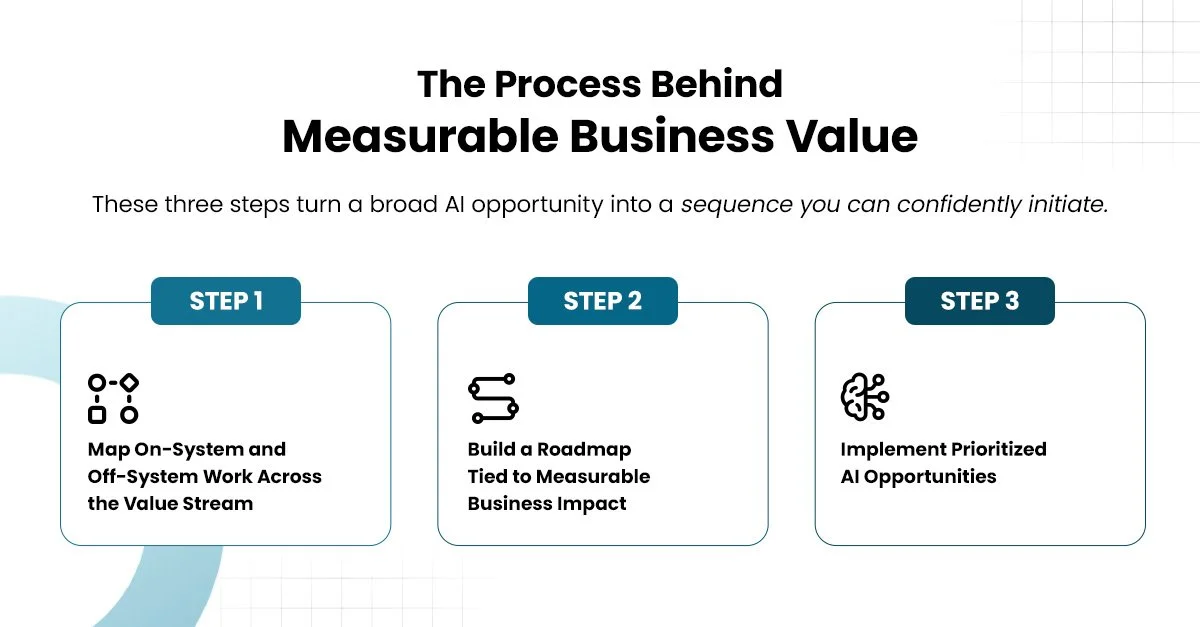
1. Map On-System and Off-System Work Across the Value Stream
Senior business analysts observe your operations firsthand and speak directly with the employees responsible for each activity, rather than relying on process documentation alone. That meticulous review follows work wherever it happens, across your organization's ERPs, WMSs, email, spreadsheets, portals and the handoffs between teams.
This value stream mapping shows how information and decisions move between functions. It then applies task-level analysis to evaluate each activity for automation, augmentation of employee judgment or continued human decision-making. The resulting documentation establishes the purpose of each opportunity and the responsibilities a reliable solution should enable.
2. Build a Roadmap Tied to Measurable Business Impact
Use the findings from your assessment to create a strategic plan that organizes:
Prioritized recommendations
A suggested solution stack
Implementation estimates
Expected business impact
A well-designed roadmap gives you a predictable path from assessment to action. Compare every opportunity using consistent criteria, weighing operational relevance, expected impact and practical implementation considerations.
Because this approach remains software-agnostic, recommendations focus on your business processes and operating environment rather than any single platform. That keeps the mission applicable across different implementation paths, while resource alignment and defined operational measures enable more informed investment decisions.
3. Implement Prioritized AI Opportunities
Implementation paths vary by opportunity and may include purpose-built agents, custom workflow applications or managed deployment of selected third-party tools. When centralized access fits your organization's needs, an AI-hosted platform can provide a single, secure portal for approved tools and purpose-built solutions.
Using AI-enabled solutions for businesses becomes more practical when you connect technical delivery to adoption and governance rather than treating it as a separate step. Client-specific training suggests approved tools, defines each employee's responsibilities and illustrates where human judgment still belongs within a given workflow. Data protection standards guide how each tool handles sensitive information.
Ongoing operational support carries this work forward, helping employees recognize recurring patterns and evaluate new opportunities as your business needs develop.
The First Steps Organizations Take to Implement AI Use
Workforce readiness, process clarity and planned scope all influence the most appropriate entry point. You might begin with employee preparation or single out a specific operational priority, depending on where your organization stands today. Each path leads toward the same coordinated advisory model, just from a different starting position.
Prepare People for Responsible AI Adoption
Training and governance establish shared expectations before wider AI adoption takes hold. Employees will learn which tools are best to use, how AI fits into their work and what responsibilities remain theirs alone, giving every participating department a consistent foundation for responsible adoption.
Focus on One Operational Priority
A focused starting point revolves around one high-priority operational process rather than your entire organization. End-to-end mapping evaluates individual tasks to determine where AI can take over and where human insight must remain part of the process, and the resulting use case provides a concrete way to assess potential impact while building internal confidence in the approach.
Map the Current State and Build Targeted Tactics
A broader assessment connects your on-system workflows with off-system work across the organization, producing a prioritized set of opportunities. Each one comes with a recommended solution, a rough timeline and the outcomes it should deliver. The resulting business plan enables investment planning across several processes or departments at once, rather than a single isolated fix. You retain control over pace and scope as priorities, readiness and budgets develop over time.
Build an Actionable AI Advisory Plan With Strategic Information Group
A continuous advisory relationship connects assessment and roadmap development with training, governance, custom AI solutions, managed deployments and ongoing operational support. Strategic applies this complete advisory model throughout every engagement, drawing on proprietary tools and vertical-specific depth built for manufacturing, life sciences, food and beverage, automotive and high-tech operations.
More than 30 years of experience across these industries informs our approach to your business processes. Contact our team when you're ready to explore an AI advisory starting point aligned with your people, processes and priorities.